AI Insights Library User Guide and Index — Helping Leaders and Decision Makers Navigate AI
- Mar 24
- 7 min read
Updated: Jul 15
1. Library Objective
The Orr Consulting AI Insights Library is designed to help leaders and decision makers navigate artificial intelligence in a practical, structured way.
It helps leaders and decision makers cut through AI noise and make better AI business decisions through structured AI thinking.
Its purpose is to help organisations answer four fundamental questions:
What is AI and what can it do for your organisation? (AI Universe)
What challenges can arise when seeking to deliver AI-enabled transformation? (AI Business Problems)
How can you implement AI in a structured, effective way? (AI Transformation Process)
What does structured AI transformation look like in practice? (AI Case Studies)
The library is made up of short, accessible AI Insights designed to help leaders and decision makers cut through AI noise and make better AI business decisions through structured AI thinking. Individual Insights can be read on their own or explored as part of the wider library. Together, they support a structured approach to understanding AI, identifying value, managing risk and delivering organisational benefits.
2. AI Universe
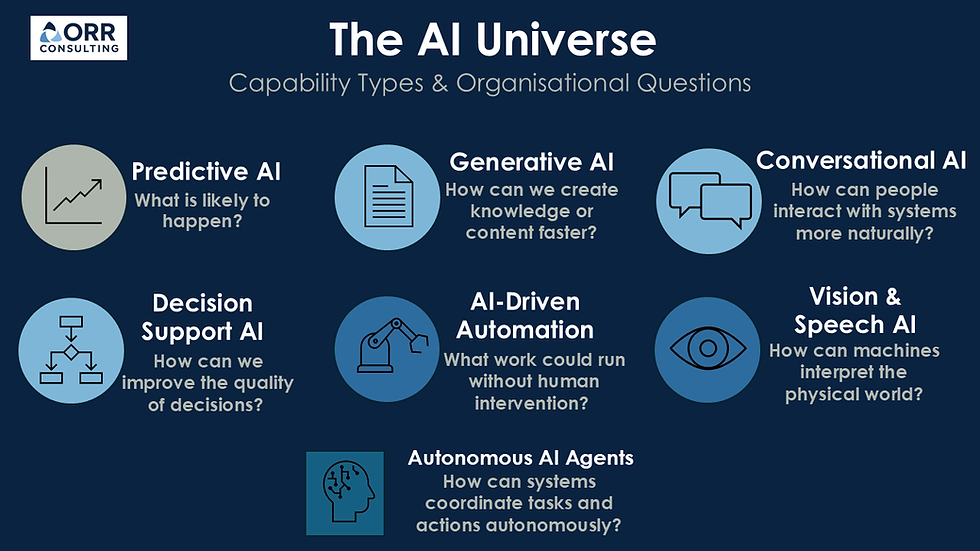
The Orr Consulting AI Universe provides non-technical guidance on current AI capabilities.
These Insights are written for leaders and decision makers who want a clear view of what AI can do today, where it is already being applied and what is realistic in an organisational setting.
This section helps leaders, teams and delivery functions build a more practical and shared understanding of AI.
Within this section, readers can explore foundational AI concepts, common organisational challenges and practical case studies that support more informed AI-enabled transformation.
Each capability Insight typically covers:
the value delivered and typical applications
applicability and constraints
benefits organisations seek
risks and limitations
practical mitigations
This section is intended to build clarity and confidence, enabling better decision-making before investment or adoption.

3. AI Business Problems
The library also includes AI Business Problems Insights. These surface common organisational tensions, risks and practical challenges that arise in AI-enabled transformation.
They are designed to help readers recognise familiar issues quickly and then move naturally into the relevant Solution Insight and, where available, a supporting Case Study.
This makes AI Business Problems an important front-door route into the library, helping readers move from a recognised challenge to the relevant Insight, structured response and practical example.
4. AI Transformation Process
Successful AI adoption is rarely about technology alone. Organisations often struggle more with strategy, governance, readiness and delivery discipline than with tools.
The Orr Consulting AI Transformation Process provides a structured, staged and scalable approach to AI transformation:
Discover → Design → Deliver
These Insights introduce the Orr Consulting AI Transformation Process and show how AI-enabled transformation can be approached in a structured, practical and controlled way. The category begins with the core Process Insight, followed by the overarching organisational problem it is designed to address, the individual transformation process steps, and a case study showing how fragmented AI activity can begin to be brought back under programme control in practice.
Together, these Insights provide a guide for moving from initial AI curiosity and experimentation to structured adoption, controlled delivery and measurable value.

5. AI Case Studies
The library also includes AI Case Studies that illustrate how the Orr Consulting AI Transformation Process and AI capabilities can be applied in practice.
The case studies are grouped into two complementary categories:
AI Capability Case Studies demonstrate how specific AI capabilities from the Orr Consulting AI Universe can be assessed, governed, implemented or challenged within real organisational situations. These case studies focus on practical application, outcomes, risks and lessons learned
AI Services Case Studies demonstrate how individual Discover, Design and Deliver services from the AI Transformation Process can be applied to address specific organisational needs and challenges.
Together, the case studies help readers move from understanding concepts and frameworks to seeing how structured AI transformation can operate in practice.
6. The ORR AI Assistant
The library is also supported by the ORR AI Assistant, a conversational AI digital assistant that helps visitors ask practical questions and navigate towards relevant Insights, case studies and AI transformation resources.
This provides an additional route into the library for readers who prefer to explore AI topics through conversation rather than through the structured index.
7. Index
The following index provides a structured view of all Insights within the Orr Consulting AI Insights Library, grouped by the Library’s main navigation routes and, where relevant, aligned to the AI Transformation Process.
7.1 AI Universe Insights
The Current AI Universe — What Leaders and Decision Makers Need to Know
Predictive AI — What is likely to happen?
Generative AI — How can we create knowledge or content faster?
Generative AI - Maximising Benefits with Prompt Engineering
Conversational AI — How can people interact with systems more naturally?
Decision Support AI — How can we improve the quality of decisions?
AI-Driven Automation — What work could run without human intervention?
Vision & Speech AI — How can machines interpret the physical world?
Autonomous AI Agents — How can systems co-ordinate tasks and actions autonomously?
7.2 AI Business Problems
The AI Noise Problem — Why Leaders Need More Structure, Not More Hype (AI Insights Library)
When AI Starts With a Single Urgent Problem — and Ends in Fragmentation (AI Transformation Process)
Discover Stage
Why Leadership Teams Lack a Shared Way to Think About AI (Discover - AI Education and Training)
The AI Confidence Gap — Why Leaders Struggle to Answer “How Mature Is Our AI Capability?” (Discover — AI Capability and Maturity)
Why Many AI Pilots Feel Like a Solution Looking for a Problem (Discover — AI Use Case Discovery)
Design Stage
The Board Keep Asking — What Are We Doing About AI? (Design — AI Strategy Development)
The Corporate Risk of Uncontrolled (Shadow) AI (Design — AI Governance and Assurance)
When AI Enthusiasm and Urgency Get Ahead of the Business Case (Design — AI Business Case Development)
Deliver Stage
When AI Ambition Grows Faster Than Programme Control (Deliver — AI Programme Management)
When AI Delivery Refuses to Behave Like a Normal Project (Deliver — AI Project Management)
When People Readiness Becomes the Biggest Risk to AI Benefits Realisation (Deliver — AI Benefits Realisation)
7.3 AI Transformation Insights
The AI Transformation Process — Maximising Benefits and Reducing Risk
Discover Stage
AI Education and Training — Building Organisational Understanding
AI Capability and Maturity Assessment — Understanding Readiness
AI Use Case Discovery — Identifying and Prioritising Opportunities
Design Stage
AI Strategy Development — Defining Direction and Priorities
AI Governance and Assurance — Managing Risk and Control
AI Business Case Development — From Strategy to Defensible Investment
Deliver Stage
AI Programme Management — Adapting Programme Leadership for AI Delivery
AI Project Management — Adapting Project Delivery for AI
AI Benefits Realisation — Ensuring AI Delivery Translates into Measurable Value
7.4 AI Case Studies
AI Capability Case Studies
AI Services Case Studies
Discover Stage
AI Services Case Study - Building Shared Leadership Understanding of AI (Discover — AI Education and Training)
AI Services Case Study — Performing an AI Capability and Maturity Assessment (Discover — AI Capability and Maturity)
AI Services Case Study — Performing AI Use Case Discovery and Prioritisation (Discover — AI Use Case Discovery)
Design Stage
AI Services Case Study — Developing an AI Strategy and Roadmap (Design — AI Strategy Development)
AI Services Case Study — Sample Board Paper: AI Governance and Assurance (Design — AI Governance and Assurance)
AI Services Case Study — Developing an AI Business Case for Scaling Generative AI Licenses (Design — AI Business Case Development)
Deliver Stage
AI Services Case Study — Bringing Fragmented AI Activity Back under Programme Control (Deliver — AI Programme Management)
AI Services Case Study — Maintaining Project Control in a High Uncertainty AI Pilot (Deliver — AI Project Management)
AI Services Case Study — Defining, Tracking and Evidencing Benefits from a Generative AI Pilot (Deliver — AI Benefits Realisation)
8. Library Navigation
If you want to understand AI capabilities and what they can do, begin with AI Universe.
If you want to understand common problems, tensions and risks that can arise during AI-enabled transformation, begin with AI Business Problems.
If you want to understand the overall structured approach to AI transformation, begin with AI Transformation Process.
If you want to see how structured approaches are applied in practice, begin with AI Case Studies.
Readers can then move more deeply into the relevant transformation steps through the detailed process-step categories.
9. Insight Sequencing
Within most business problems and transformation-step categories, Insights are sequenced as:
Problem Insight
Solution Insight
Case Study Insight
This allows readers to move from the issue itself, to the structured Orr Consulting response and then to a practical example of how that response can be applied.
The sequence is designed to make the library easier to navigate and to help readers move more naturally from recognition of a problem to a clearer understanding of what to do next.
10. Final Thoughts
Artificial intelligence presents significant opportunities, but successful adoption depends on structured thinking, disciplined delivery and effective governance.
The Orr Consulting AI Insights Library is intended to provide clear, practical guidance to support that journey. Explore the articles most relevant to your organisation and use them to shape informed, confident decisions about your next AI steps.
11. Next AI Steps
If your organisation is exploring AI opportunities or would benefit from a structured approach to adoption, it may be helpful to discuss your current situation and potential next steps.
Subscribe to Orr Consulting to receive occasional emails with practical AI Insights and updates.
12. Glossary
The Glossary explains the terminology used throughout the AI Insights Library and introduces the concepts that underpin the Orr Consulting approach to AI transformation.