Vision and Speech AI — Capabilities, Benefits and Risks for Leaders and Decision Makers
- Jan 15
- 5 min read
Updated: Jul 24
1. Insight
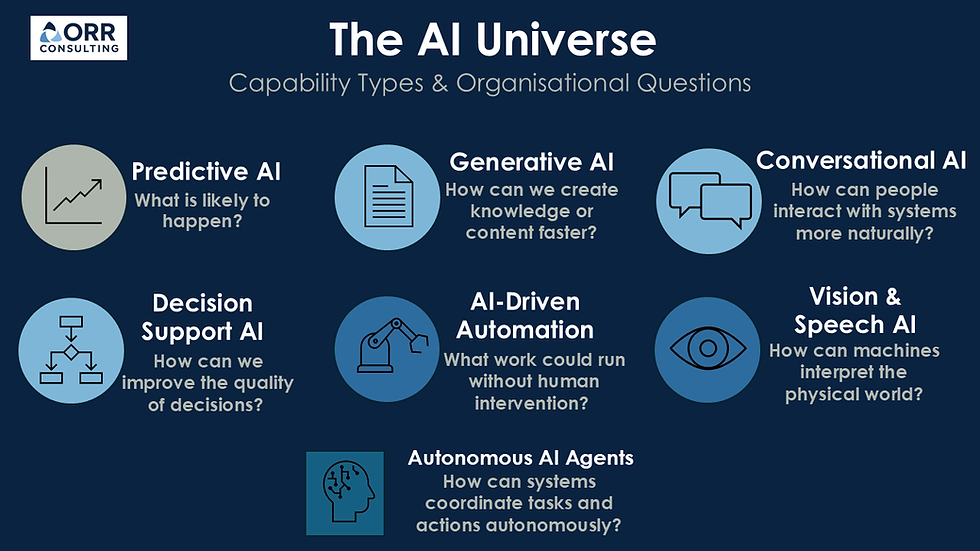
In the Orr Consulting AI Universe overview, Vision and Speech AI addresses a fundamental organisational question:
"How can machines interpret the physical world?"
Vision and Speech AI refers to technologies that allow machines to interpret visual and audio information in ways that previously required human perception.
These capabilities include computer vision systems that analyse images and video, and speech technologies that recognise, interpret and generate spoken language.
Together, these technologies allow machines to observe environments, detect events and interpret human communication.
Vision and Speech AI are widely used in areas such as quality inspection, safety monitoring, identity verification, accessibility technologies and voice-driven digital assistants.
For leaders and decision makers, these capabilities can deliver meaningful operational benefits by improving monitoring, enabling automation in physical environments and making digital systems more accessible.
However, these technologies must be deployed carefully. Visual and audio data often involve sensitive information, and systems must be designed to operate reliably in real-world conditions.
Understanding both the potential and the limitations of Vision and Speech AI is therefore important when considering where these capabilities can strengthen organisational operations.

2. Why This Matters
Many organisational activities depend on interpreting visual or spoken information.
Examples include:
Inspecting physical assets or products
Monitoring environments for safety or compliance
Recognising individuals or objects
Interpreting spoken instructions or conversations
Transcribing meetings or interactions
Historically, these tasks have required human attention and judgement.
Vision and Speech AI can assist with these activities by enabling machines to interpret images, video and audio data at scale.
When applied appropriately, these capabilities can:
Improve operational monitoring
Support safety and compliance
Enable automation in physical environments
Increase accessibility of digital services
However, these technologies also introduce important considerations, including privacy, accuracy and reliability in complex real-world environments.
In the Orr Consulting AI Transformation Process, this Insight supports the Discover stage — building a shared understanding of AI capability, benefits and risk before governance and investment decisions are made.

3. In Practice
3.1 What Vision and Speech AI Is
Vision and Speech AI refers to systems that interpret visual and audio inputs using machine learning and advanced signal processing.
These systems can analyse information from sources such as:
Cameras and video feeds
Photographs or scanned documents
Microphones and audio recordings
Live speech interactions
Vision AI focuses on recognising patterns in images or video, such as identifying objects, detecting anomalies or analysing visual conditions.
Speech AI focuses on recognising spoken language, converting speech to text, understanding intent and generating natural spoken responses.
Together, these capabilities allow machines to interpret aspects of the physical world in ways that previously required human perception.
3.2 Important Distinction
Not all image or speech processing is AI.
Traditional image processing and speech technologies have existed for many years, using predefined rules, signal processing techniques or fixed algorithms to analyse visual or audio information.
Vision and Speech AI extends these capabilities by enabling systems to recognise patterns, detect anomalies and interpret complex visual or spoken information using machine learning models rather than relying solely on predefined rules.
This distinction matters because organisations should not assume that every camera system, optical character recognition solution or speech recognition application necessarily uses AI. In many situations, conventional technologies remain entirely appropriate.
3.3 Applicability
Vision and Speech AI are particularly effective when:
Large volumes of visual or audio data must be analysed
Events need to be detected quickly or continuously
Human monitoring would be time-consuming or inconsistent
Accessibility can be improved through speech interaction or transcription
In these situations, AI-assisted interpretation can improve efficiency while supporting human oversight.
3.4 Common Use Cases
These capabilities are widely applied across many industries.
Common examples include:
Quality inspection — Analysing images or video to detect defects in products or infrastructure
Safety monitoring — Identifying hazards or unsafe behaviour in operational environments
Identity verification — Recognising faces or biometric characteristics in secure environments
Speech transcription — Converting meetings or interactions into searchable text
Voice interfaces — Enabling users to interact with systems through spoken commands
3.5 What Vision and Speech AI Is Not
Vision and Speech AI systems are powerful tools, but they do not replicate full human perception.
These technologies:
Do not understand context in the same way humans do
Can struggle in unfamiliar environments or poor data conditions
Require careful training and validation
Still require human oversight in many applications
For this reason, these capabilities are usually deployed to assist human decision-making rather than replace it entirely.
3.6 Benefits in Practice
Vision and Speech AI can deliver several organisational benefits when applied appropriately.
Typical benefits include:
Improved monitoring and detection — Allowing organisations to identify events or anomalies quickly
Enhanced safety and compliance — Supporting continuous monitoring in complex environments
Greater operational efficiency — Reducing the need for manual inspection or transcription
Improved accessibility — Enabling speech-driven interaction and automated transcription services
3.7 Requirements for Success
Successful deployment of Vision and Speech AI depends on several organisational foundations.
This typically requires:
High-quality data inputs — Such as reliable camera feeds or clear audio recordings
Well-defined operational use cases — Where the system’s outputs inform real decisions or actions
Appropriate governance and privacy controls — Particularly where personal data may be involved
Human oversight and validation — Ensuring outputs are interpreted and used appropriately
3.8 Delivery Considerations
From an AI Project Management perspective, Vision and Speech AI is most commonly associated with the Configure delivery mode, where organisations implement and integrate established computer vision or speech capabilities within commercial platforms, enterprise applications or specialist solutions.
Where organisations develop bespoke models, integrate highly specialised hardware or create organisation-specific Vision and Speech AI capabilities, a Build delivery mode approach may also be appropriate.
In typical organisational delivery terms, Vision and Speech AI sits in the medium-to-high range of the AI delivery complexity spectrum.
While the underlying technologies are well established, real-world deployment often involves hardware integration, environmental variability and operational change.
Lighting conditions, background noise, camera placement and other environmental factors can all affect system performance.
For this reason, while Vision and Speech AI can deliver significant operational benefits, successful organisational adoption still benefits from a structured approach to AI transformation, including clear strategy, effective governance and disciplined delivery.
4. Risks
Key risks include:
Privacy and data protection concerns — Particularly when capturing images, video or audio involving individuals
Accuracy limitations — Especially in challenging environments such as low light or noisy conditions
Over-reliance on automated interpretation — Without appropriate human review
Regulatory exposure — Particularly in areas such as biometric identification
5. Mitigating Actions
Leaders can reduce these risks by:
Ensuring strong data governance and privacy protections
Testing systems thoroughly in real operational environments
Maintaining appropriate human oversight for high-impact decisions
Clearly defining how outputs are used within operational processes
Vision and Speech AI initiatives should be aligned with broader organisational governance and operational objectives.
6. Final Thoughts
Vision and Speech AI extends the reach of digital systems into the physical world.
By enabling machines to interpret images, video and spoken language, these technologies allow organisations to monitor environments, improve accessibility and support operational decision-making in new ways.
However, these capabilities must be applied thoughtfully. Accuracy, privacy and governance considerations are particularly important when systems interpret visual or audio information involving people or sensitive environments.
When introduced as part of a broader AI transformation approach supported by clear strategy, effective governance and disciplined delivery, Vision and Speech AI can become a valuable capability for improving operational performance, safety and accessibility.
This Insight is part of the Orr Consulting AI Insights Library — structured thinking for AI transformation leaders and decision makers.
7. Call to Action
If your organisation is exploring how Vision and Speech AI could improve monitoring, accessibility or operational insight, a useful starting point is to identify areas where interpreting visual or audio information currently requires significant manual effort.
If you would like support identifying opportunities, shaping governance or integrating these capabilities safely into operational services, Orr Consulting can help.
Subscribe to Orr Consulting to receive occasional emails with practical AI Insights and updates.