Why Leadership Teams Lack a Shared Way to Think About AI
- Mar 20
- 4 min read
Updated: May 14
1. Insight
AI is often presented as a completely new category of technology that organisations must urgently understand and adopt. The rapid growth of AI tools, vendor announcements and media coverage can create the impression that leaders are facing a fundamentally unfamiliar challenge.
In reality, many of the organisational problems that AI helps solve are not new.
Forecasting demand, detecting fraud, prioritising risk, planning capacity and maintaining complex assets have been part of organisational management for decades. What has changed is the capability of the technology available to address these problems.
Modern AI systems can analyse large volumes of data, identify patterns and support decision-making in ways that were previously difficult or impractical. In this sense, AI is best understood not as a completely new set of challenges, but as the next generation of tools applied to familiar organisational problems.
In many organisations, the difficulty is not simply lack of interest in AI, but lack of a clear and shared way to think about it. One leader may think mainly about automation, another about risk, another about generative tools and another about data. Without a common frame for discussing AI, leadership conversations can quickly become fragmented, making it harder to align decisions, set direction and move forward in a coordinated way.
2. Why This Matters
When AI is framed purely as a new technology trend, organisations often respond in one of two ways: enthusiasm without structure, or hesitation driven by uncertainty.
Neither response leads to sustainable value.
A more constructive approach is to recognise that AI builds on many practices organisations already understand. Forecasting, planning, risk management and operational optimisation are well-established management disciplines. AI simply introduces more advanced capabilities for performing these activities.
Understanding AI in this way helps leaders move beyond the hype cycle and focus on practical organisational questions. It also helps leadership teams build a shared frame of reference. Without that, discussions about AI can remain vague, inconsistent or overly shaped by individual assumptions. A more useful shared way to think about AI creates better conversations, better decisions and a stronger foundation for action.
The result is often not lack of activity, but lack of shared understanding at leadership level.
3. Familiar Problems
Many of the areas where AI now creates value are areas where organisations have long invested in analytical or decision-support tools.
For example:
Demand forecasting has historically relied on statistical models and planning tools. Predictive AI can now identify patterns across larger datasets and update forecasts dynamically
Fraud detection has traditionally depended on rule-based systems and predefined thresholds. Machine learning models can now detect unusual behaviour patterns that static rules might miss
Risk scoring has often been based on weighted scoring models or manual assessments. AI can support more sophisticated risk analysis by learning from historical outcomes
Capacity planning has typically relied on spreadsheets, planning systems or static models. AI can analyse demand patterns and operational constraints to improve planning decisions
Maintenance planning has historically followed scheduled inspection cycles. Predictive maintenance models can now analyse sensor data and equipment behaviour to anticipate failures earlier
In each of these examples, the organisational problem is not new. What has changed is the capability of the technology used to address it.
4. What AI Changes
Modern AI systems introduce several capabilities that make them particularly valuable for these familiar organisational challenges.
First, AI systems can analyse significantly larger volumes of structured and unstructured data than traditional analytical tools.
Second, machine learning models can identify complex patterns in data without requiring every rule to be defined manually.
Third, AI systems can update their models as new data becomes available, allowing insights and predictions to evolve over time.
These capabilities allow organisations to improve the quality of forecasting, automate certain analytical tasks and support more consistent decision-making.
However, the underlying management objectives remain the same: improving efficiency, reducing risk and supporting better decisions.
5. Leadership Implications
For leaders and decision makers, the most important implication is that AI adoption should begin with organisational problems rather than technology. Just as importantly, leadership teams need a shared and useful way to think about AI before they can make good collective decisions about where it should and should not be applied.
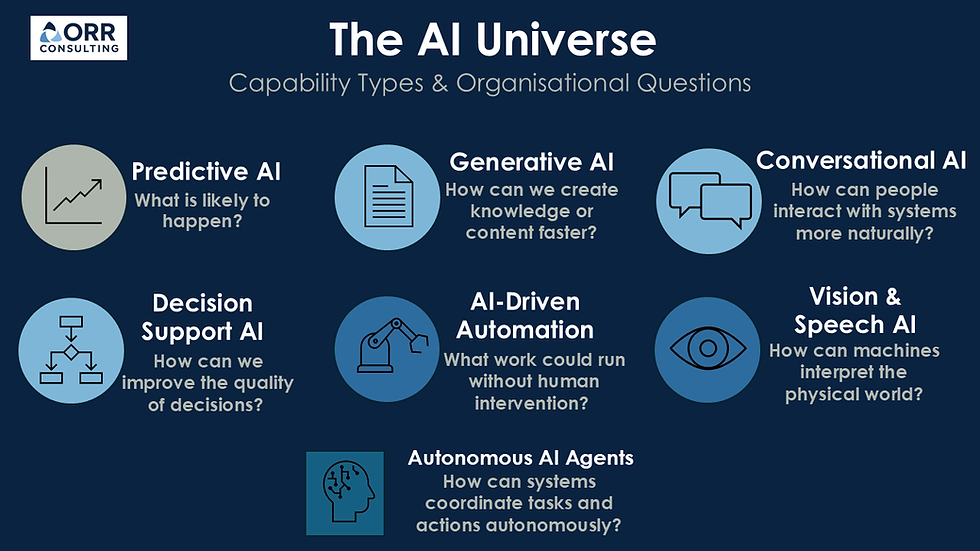
A productive starting point is to consider the core organisational questions AI can help answer:
What is likely to happen? — Predictive AI
How can we create knowledge or content faster? — Generative AI
How can people interact with systems more naturally? — Conversational AI
How can we improve the quality of decisions? — Decision Support AI
What work could run without human intervention? — AI-Driven Automation
How can machines interpret the physical world? — Vision and Speech AI
How can systems coordinate tasks and actions more autonomously? — Autonomous AI Agents
These questions help organisations identify areas where modern AI capabilities may deliver meaningful value.
Starting with organisational challenges rather than tools also reduces the risk of fragmented experimentation and helps ensure that AI initiatives remain aligned with strategy, governance and measurable outcomes.
The Orr Consulting AI Universe is a practical place to start. It explains the main AI capability types and the organisational questions they help answer.

6. Final Thoughts
Artificial Intelligence is an important technological development, but it does not introduce a completely new category of organisational challenge.
Most AI applications simply apply modern data-driven capabilities to problems that organisations have been managing for many years.
When leadership teams view AI in this way, the topic becomes less about chasing tools and more about improving the way familiar organisational challenges are addressed. More importantly, it gives them a shared and useful frame for discussing AI consistently, making decisions with greater confidence and identifying where AI may genuinely add value.
This Insight is part of the Orr Consulting AI Insights Library — structured thinking for AI transformation leaders and decision makers.
7. Call to Action
If your leadership team does not yet have a shared and useful way to think about AI, the next step is not to start with tools, but to build a clearer common frame of reference.
If you would like to discuss how to build that shared understanding in your organisation, we would welcome the opportunity to continue the conversation.
Subscribe to Orr Consulting to receive occasional emails with practical AI Insights articles and updates.