AI Services Case Study — Building Shared Leadership Understanding of AI
- Jan 30
- 4 min read
Updated: 7 days ago
1. Organisational Problem
Many organisations are now experimenting with AI tools, but leadership conversations often reveal a surprising problem: everyone is talking about AI, yet few people mean the same thing.
This case study reflects a common challenge that can emerge at any stage of an organisation’s AI transformation journey.
In the Orr Consulting AI Transformation Process, this case study demonstrates the Discover-stage role of AI Education and Training in helping organisations establish shared understanding before exploring AI opportunities and investment.

2. Situation
A UK-based recruitment and talent advisory firm had begun exploring artificial intelligence through a mixture of vendor capabilities and small-scale experimentation with generative AI tools.
Interest in AI was growing rapidly across the organisation. Board members were asking about strategic opportunities, while different departments were beginning to test tools that promised productivity gains or automation benefits.
However, leadership discussions about AI were becoming increasingly confused.
Different teams were using the term AI to describe very different things. Some were referring to generative AI tools such as ChatGPT or Copilot. Others were discussing automation, analytics or vendor systems that claimed to include AI capabilities.
As a result, conversations about AI were becoming fragmented and unproductive. Expectations were diverging, terminology was inconsistent and it was becoming difficult to have clear strategic discussions about how the organisation should approach AI.
The board recognised that before further pilots or investment were considered, the leadership team needed a shared understanding of what AI actually meant in practice.
The organisation therefore engaged Orr Consulting to deliver a focused programme of AI education and leadership awareness.
3. Background
The organisation operated across several UK locations with a well-established digital and client service environment.
Several existing software platforms already included AI-driven capabilities such as forecasting tools and automated workflow functions. At the same time, individual teams had begun experimenting with generative AI tools for tasks such as drafting candidate communications, summarising CVs and role profiles, and preparing client-facing materials.
While these early experiments were promising, they were happening without a consistent framework for understanding AI capability, benefits or risk, particularly where AI might influence candidate communications, screening or evaluation.
The organisation had effectively entered what one executive described as a “Tower of Babel” moment, where everyone was talking about AI but using different language and assumptions.
The objective was not to turn leaders into technical specialists. It was to establish a shared understanding of AI capabilities, practical use cases, potential benefits and material risks so that future discussions and decisions could proceed from a common foundation.
4. Action Taken
Orr Consulting delivered a focused programme of AI education and leadership awareness for the senior leadership team.
The sessions were designed to establish a shared understanding of AI capabilities, practical applications, potential benefits and material risks.
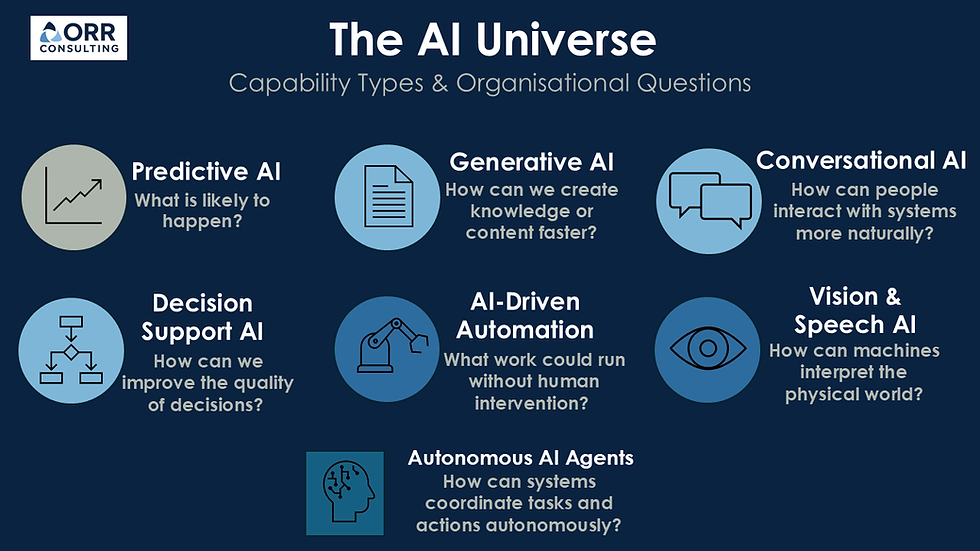
The programme introduced three core concepts:
The AI Universe — explaining the principal AI capability types and the organisational questions they help answer
Practical AI use cases — illustrating where different AI capabilities could create operational, service or strategic value
The AI Transformation Process — outlining a structured approach to assessing, prioritising and adopting AI safely and effectively
The programme established a shared vocabulary and mental model so that leadership discussions about AI could become clearer, more realistic and more productive.
It also created a common foundation for considering future AI opportunities, risks and investment decisions.

5. Outcomes
The engagement created several notable outcomes, observations and lessons learned.
5.1 Shared Leadership Vocabulary
Leaders developed a common vocabulary for discussing AI capabilities, use cases, benefits and risks.
This reduced confusion created by different teams using the term AI to describe different technologies and activities.
5.2 More Productive Discussions
Leadership discussions became clearer, more realistic and more focused on organisational needs rather than individual tools or vendor claims.
This improved the quality of strategic conversations about where AI might genuinely create value.
5.3 Improved Risk Awareness
Leaders developed greater awareness of the risks, governance considerations and human-accountability requirements associated with different forms of AI.
This reduced the risk of treating all AI capabilities as equivalent or assuming that small-scale experimentation could proceed without appropriate oversight.
5.4 Reduced Fragmentation
The organisation gained a clearer basis for coordinating AI activity across departments.
This helped move the conversation away from disconnected experimentation and towards a more deliberate organisational approach.
5.5 Stronger Decision Readiness
The leadership team was better prepared to assess future AI opportunities, challenge assumptions and consider investment choices from a shared foundation.
This created stronger readiness for subsequent AI Capability and Maturity Assessment and AI Use Case Discovery activity.
A structured AI Benefits Realisation approach could then be used to define how improved decision quality, reduced fragmentation and stronger investment discipline would be evidenced through subsequent transformation activity.
5.6 Education Before Adoption
The engagement reinforced an important lesson: organisations should establish shared leadership understanding before attempting to prioritise or scale AI initiatives.
Education did not determine which AI investments should proceed. It created the common understanding needed to make those later decisions more effectively.
6. Final Thoughts
Shared leadership understanding is an essential foundation for effective AI transformation.
When leaders use different language, assumptions and mental models, AI discussions can quickly become fragmented and technology-led.
A focused programme of AI Education and Training can establish a common understanding of AI capabilities, practical opportunities, benefits and risks without requiring leaders to become technical specialists.
In this case, the most important outcome was not agreement on a particular AI solution. It was creating the shared foundation required for clearer discussion, stronger assessment and better-informed future decisions.
This AI Services Case Study is part of the Orr Consulting AI Insights Library — structured thinking for AI transformation leaders and decision makers.
If your organisation would benefit from stronger leadership understanding, capability assessment or structured use case discovery, we would be pleased to discuss your next AI steps.
Subscribe to Orr Consulting to receive occasional emails with practical AI Insights and updates.