Autonomous AI Agents — Capabilities, Benefits and Risks for Leaders and Decision Makers
- Jan 14
- 4 min read
Updated: Jul 19
1. Insight
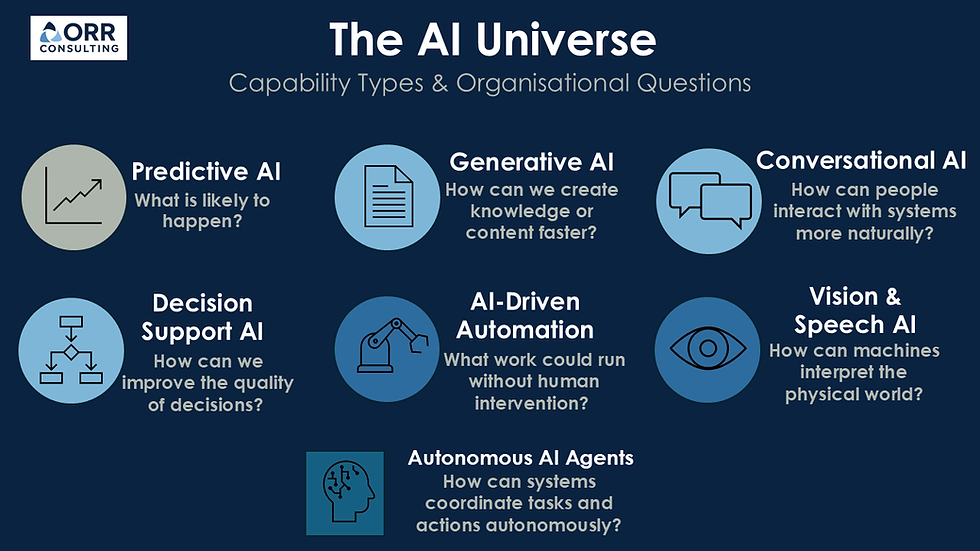
In the Orr Consulting AI Universe overview, Autonomous AI Agents address a fundamental organisational question:
"How can systems coordinate tasks and actions more autonomously?"
AI agents are systems that can plan, coordinate and execute tasks in pursuit of a defined objective.
Unlike most AI tools that perform a single function, agents can combine several capabilities — such as generative AI, predictive models, decision support and automation — to complete multi-step activities.
This allows systems to move beyond isolated tasks and begin performing sequences of actions, such as gathering information, analysing options, generating outputs and triggering follow-up actions.
AI agents are increasingly being explored and used in areas such as research assistance, operational coordination, digital workflows and software development.
For leaders and decision makers, the potential benefits are significant. AI agents can improve productivity, reduce manual coordination and enable more autonomous digital operations.
However, agents also introduce important considerations. Because they can act with greater autonomy, governance, oversight and operational controls become even more important.
Understanding both the potential and the risks of AI agents is therefore essential as organisations explore how AI capabilities may evolve in the coming years.

2. Why This Matters
Most organisational work is not a single task. It usually involves a sequence of activities.
For example:
Gathering information
Analysing data
Making a recommendation
Generating documentation
Triggering follow-up actions
Traditionally, these steps require human coordination between different systems, tools and teams.
AI agents aim to reduce this coordination burden by allowing software systems to orchestrate multiple steps automatically.
When applied appropriately, AI agents can:
Automate complex workflows
Accelerate knowledge work
Reduce manual coordination between systems
Improve operational responsiveness
However, because agents can perform multiple actions autonomously, they also raise questions about control, accountability and reliability.
In the Orr Consulting AI Transformation Process, this Insight supports the Discover stage — building a shared understanding of AI capability, benefits and risk before governance and investment decisions are made.

3. In Practice
3.1 What AI Agents Are
AI agents are systems that pursue goals by combining multiple AI capabilities and interacting with digital tools or environments.
Unlike generative AI tools that individuals can access directly, AI agents are usually embedded within connected systems, workflows or digital environments rather than used as standalone tools.
An agent typically operates by:
Interpreting an objective or task
Planning the steps required to achieve it
Interacting with systems or data sources
Evaluating results and adjusting actions
In practice, agents often rely on several underlying technologies including generative AI, predictive models, decision support systems and automation tools.
Rather than performing a single function, agents orchestrate these capabilities to complete broader tasks.
3.2 Applicability
AI agents are particularly effective when:
Tasks involve multiple steps or tools
Information must be gathered from several sources
Workflows require coordination across systems
Objectives can be clearly defined
In these scenarios, agents can help reduce manual coordination and improve productivity.
3.3 Common Use Cases
AI agents are increasingly used in areas such as:
Research and analysis — Gathering information from multiple sources and summarising findings
Software development assistance — Writing, testing and refining code across multiple iterations
Workflow orchestration — Coordinating multi-step digital processes
Digital operations support — Monitoring systems and triggering responses to operational events
3.4 What AI Agents Are Not
AI agents are sometimes described as fully autonomous digital workers.
In reality, most current agents:
Operate within defined boundaries and systems
Require human oversight and governance
Depend heavily on the quality of underlying tools and data
Can still make errors or misinterpret objectives
For this reason, agents are best viewed as assistive systems that augment human work, rather than independent decision-makers.
3.5 Benefits in Practice
AI agents can deliver several organisational benefits when applied appropriately.
Typical benefits include:
Improved productivity — Enabling complex tasks to be completed more quickly
Reduced coordination effort — Allowing systems to manage multi-step workflows
Faster analysis and response — Particularly where information must be gathered from multiple sources
Greater operational scalability — Allowing organisations to manage larger volumes of digital activity
3.6 Requirements for Success
Effective use of AI agents depends on several organisational foundations.
This typically requires:
Clear objectives and boundaries — Ensuring agents operate within defined parameters
Reliable underlying systems — Including data sources and operational tools
Strong governance and monitoring — Particularly where agents trigger actions automatically
Human oversight — Ensuring outputs and actions are reviewed appropriately
3.7 Delivery Considerations
In typical organisational delivery terms, AI agents sit at the higher end of the AI delivery complexity spectrum.
This is because agents combine multiple capabilities and often interact with several systems simultaneously.
Designing reliable agent behaviour, managing operational risk and ensuring appropriate governance can require careful planning and experimentation.
For this reason, while AI agents have the potential to transform organisational productivity and coordination, successful organisational adoption still benefits from a structured approach to AI transformation, including clear strategy, effective governance and disciplined delivery.
4. Risks
Key risks include:
Uncontrolled autonomy — Where agents perform actions without sufficient oversight
Unexpected behaviour — Particularly when systems interpret objectives incorrectly
Security and system access risks — Where agents interact with sensitive systems or data
Accountability challenges — When actions are triggered automatically across systems
5. Mitigating Actions
Leaders can reduce these risks by:
Defining clear operational boundaries for agents
Introducing staged experimentation and testing
Maintaining strong governance and monitoring
Ensuring human oversight for high-impact actions
AI agents should be introduced gradually, with clear operational controls and governance.
6. Final Thoughts
AI agents represent an important evolution in how AI capabilities can be applied.
By combining multiple technologies into systems that can plan and coordinate actions, agents extend the potential of AI beyond isolated tasks.
However, with increased capability comes increased responsibility. Organisations must ensure that autonomy, governance and accountability remain balanced as these technologies develop.
When introduced thoughtfully as part of a broader AI transformation approach supported by clear strategy, effective governance and disciplined delivery, AI agents can become a powerful capability for improving productivity, coordination and operational effectiveness.
This Insight is part of the Orr Consulting AI Insights Library — structured thinking for AI transformation leaders and decision makers.
7. Call to Action
If your organisation is exploring how AI agents could improve workflow coordination or digital operations, a useful starting point is to identify multi-step tasks where automation, analysis and decision support could be combined.
If you would like support identifying opportunities, shaping governance or integrating AI agents safely into operational workflows, Orr Consulting can help.
Subscribe to Orr Consulting to receive occasional emails with practical AI Insights and updates.