Decision Support AI — Capabilities, Benefits and Risks for Leaders and Decision Makers
- Jan 19
- 6 min read
Updated: Jul 19
1. Insight
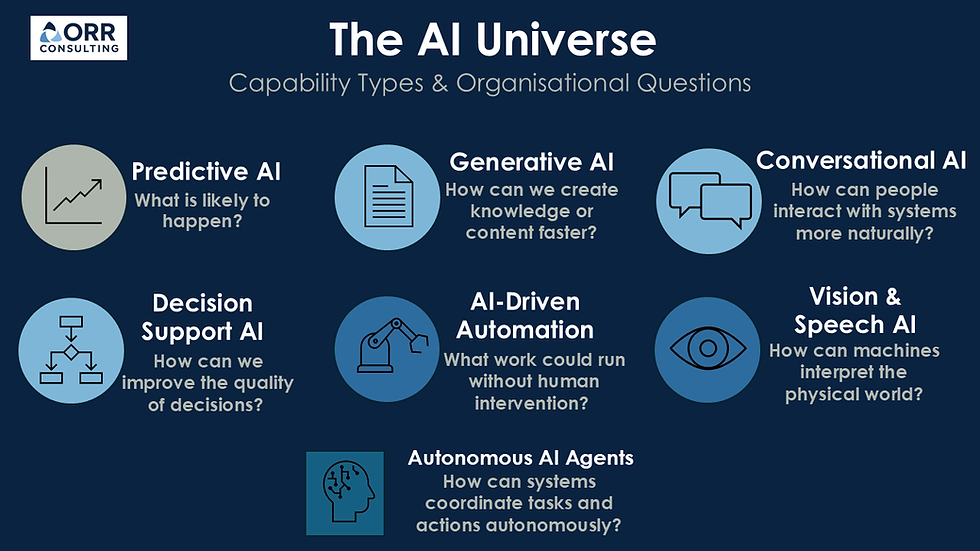
In the Orr Consulting AI Universe overview, Decision Support AI addresses a fundamental organisational question:
"How can we improve the quality of decisions?"
Decision Support AI refers to AI systems that help people make better decisions by analysing information, identifying patterns and presenting insights that support judgement and action.
These systems do not replace human decision-making. Instead, they help decision-makers understand complex information, prioritise options and evaluate likely outcomes more effectively.
Decision Support AI is widely used across sectors, including financial services, healthcare, logistics, public administration and risk management. It often works alongside other AI capabilities such as predictive modelling, optimisation algorithms and advanced analytics.
For leaders and decision makers, Decision Support AI can deliver significant organisational benefits by improving the consistency, speed and quality of operational and strategic decisions.
However, these systems must be designed carefully. If poorly implemented, decision support tools can create false confidence, obscure uncertainty or encourage over-reliance on automated recommendations.
Understanding how Decision Support AI works and where it is appropriate is therefore important when exploring how AI can strengthen organisational decision-making.

2. Why This Matters
Many organisational decisions are made in environments characterised by complexity, time pressure and incomplete information.
Examples include:
Prioritising operational workloads
Allocating resources across competing demands
Assessing risk exposure
Determining eligibility or intervention thresholds
Planning responses to changing conditions
In these contexts, decision-makers must often interpret large volumes of information quickly while balancing multiple factors.
Decision Support AI can help by analysing data, highlighting patterns and presenting structured insights that inform judgement.
When applied appropriately, this capability can:
Improve decision consistency across teams and services
Identify risks or opportunities earlier
Support evidence-based decision-making
Reduce cognitive overload in complex environments
However, the effectiveness of Decision Support AI depends heavily on how it is integrated into real decision processes. Systems that generate insights without being integrated into operational decision-making often fail to deliver meaningful organisational benefits.
In the Orr Consulting AI Transformation Process, this Insight supports the Discover stage — building a shared understanding of AI capability, benefits and risk before governance and investment decisions are made.

3. In Practice
3.1 What Decision Support AI Is
Decision Support AI provides analytical insights that help people make decisions.
Rather than generating content or automating tasks, Decision Support AI combines multiple sources of information and presents structured analysis that helps people evaluate options and make better decisions.
Users typically interact with these systems through dashboards, analytical tools or operational platforms that provide recommendations, prioritisation guidance or scenario analysis.
3.2 Applicability
Decision Support AI is particularly effective when:
Decisions involve multiple variables or complex trade-offs
Data sources are large or difficult for humans to analyse consistently
Consistent decision-making across teams is important
Structured guidance can improve prioritisation or resource allocation
In these situations, AI-assisted analysis can strengthen decision-making while still leaving final judgement with human decision-makers.
However, not every decision-support problem requires AI. Where decision criteria are already clear, stable and explainable, conventional rules-based approaches may provide a simpler, more transparent and more cost-effective solution. One of the objectives of AI Use Case Discovery is determining whether AI is genuinely required or whether alternative approaches can achieve the desired outcome.
3.3 Common Use Cases
Decision Support AI is commonly applied in areas such as:
Operational prioritisation — Helping teams decide which cases, tasks or risks should be addressed first
Resource allocation — Supporting decisions about how staff, funding or operational capacity should be distributed
Risk assessment — Analysing multiple data sources to highlight potential risks that warrant further investigation
Strategic planning — Supporting scenario analysis and forecasting to inform longer-term planning decisions
3.4 Limitations
Decision Support AI is not intended to replace human decision-making.
These systems:
Do not possess human judgement or contextual awareness
Cannot fully understand organisational nuance or policy considerations
Should not remove human accountability for decisions
Require oversight and interpretation by decision-makers
The purpose of decision support systems is to augment human judgement, not automate it entirely.
3.5 Benefits in Practice
Decision Support AI can deliver several organisational benefits when applied to appropriate decision processes.
Typical benefits include:
Improved decision consistency — ensuring similar situations are assessed using the same analytical logic
Better prioritisation — helping teams focus attention where impact or risk is greatest
Earlier identification of issues — allowing proactive intervention rather than reactive response
Reduced cognitive overload — enabling decision-makers to focus on judgement rather than data interpretation
3.6 Requirements for Success
Effective decision support systems depend less on algorithm sophistication and more on organisational foundations.
This typically requires:
Clear decision points — where it is well understood how the insight will influence action
Reliable and relevant data — ensuring recommendations are based on accurate information
Transparent models or logic — allowing decision-makers to understand how insights are produced
Integration with operational workflows — so insights are delivered at the moment decisions are made
3.7 Delivery Considerations
Decision Support AI is most commonly implemented as a capability within existing business applications and enterprise systems rather than as a standalone AI product. Many modern enterprise resource planning (ERP), customer relationship management (CRM), healthcare, finance and operational management systems increasingly incorporate AI-powered decision support alongside their existing functionality. Users typically interact with recommendations, prioritisation guidance or analytical insights through systems they already use as part of their normal work, rather than engaging directly with the underlying AI capability.
From an AI Project Management perspective, Decision Support AI is most commonly associated with the Configure delivery mode, where organisations implement and integrate AI capabilities already available within existing platforms. Where decision-making processes or organisational data are highly specific, a Build delivery mode approach may also be appropriate.
In typical organisational delivery terms, Decision Support AI sits in the medium range of the AI delivery complexity spectrum.
While the underlying analytical techniques are often well established, delivery complexity arises from integrating insights into real decision processes.
This may include connecting multiple data sources, designing usable interfaces, establishing governance and ensuring decision-makers understand how to interpret and use the outputs.
For this reason, while decision support systems can deliver meaningful benefits, successful organisational adoption still benefits from a structured approach to AI transformation, including clear strategy, effective governance and disciplined delivery.
4. Risks
Key risks include:
Over-reliance on automated recommendations — where human judgement is reduced or bypassed
Automation bias — where users gradually stop challenging AI recommendations simply because they are produced by the system
False confidence in analytical outputs — particularly when model uncertainty is not visible
Poor transparency — making it difficult for users to understand how insights are generated
Misalignment with real decision processes — resulting in insights that are ignored or unused
5. Mitigating Actions
Leaders can reduce these risks by:
Ensuring decision support tools complement human judgement rather than replace it
Making model assumptions and limitations visible to users
Designing systems around real operational decision points
Monitoring how insights are used in practice and adjusting systems accordingly
Decision Support AI should be implemented as part of broader operational improvement rather than as a standalone technology initiative.
6. Final Thoughts
Decision Support AI represents one of the most practical ways AI can strengthen organisational performance.
By helping people interpret complex information and prioritise action more effectively, these systems can improve decision quality across a wide range of operational and strategic contexts.
However, the benefits of Decision Support AI depend less on algorithm sophistication and more on thoughtful integration into real decision-making processes.
When introduced with clear governance, reliable data and strong operational alignment, Decision Support AI can become a valuable capability that enhances judgement and strengthens organisational resilience.
Equally, organisations should remain open to the possibility that a simpler rules-based approach may sometimes provide a more proportionate solution. The objective is not to introduce AI wherever possible, but to improve decision quality using the most appropriate approach.
This Insight is part of the Orr Consulting AI Insights Library — structured thinking for AI transformation leaders and decision makers.
7. Call to Action
If your organisation is exploring how AI could improve operational or strategic decision-making, a useful starting point is identifying decision processes where better prioritisation, risk assessment or insight could improve outcomes.
If you would like support identifying Decision Support AI opportunities, shaping governance or integrating decision support into operational services, Orr Consulting can help.
Subscribe to Orr Consulting to receive occasional emails with practical AI Insights and updates.