Predictive AI (Machine Learning) — Capabilities, Benefits and Risks for Leaders and Decision Makers
- Jan 23
- 6 min read
Updated: Jul 20
1. Insight
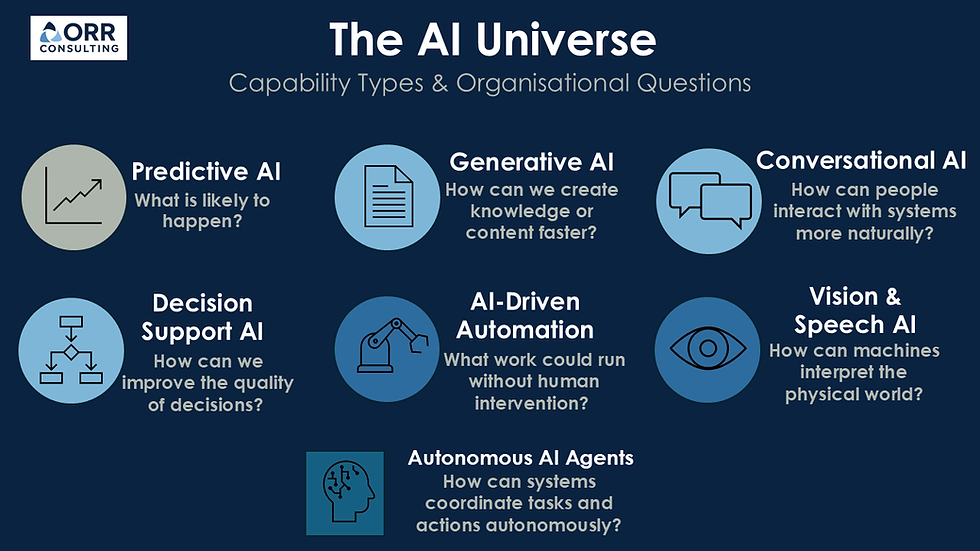
In the Orr Consulting AI Universe overview, Predictive AI addresses a fundamental organisational question: "What is likely to happen?"
Predictive AI is one of the most established and widely deployed forms of AI in organisations.
Predictive AI learns patterns from historical data to estimate what is likely to happen next and to classify what something is. It underpins familiar outcomes such as forecasting, risk scoring, fraud detection, anomaly detection and predictive maintenance.
For leaders and decision makers, Predictive AI is often the fastest route to measurable operational benefits because it is tightly linked to real decisions: when to intervene, where to allocate resources and which risks to prioritise.
However, it also introduces specific delivery and governance challenges. Predictive models can silently degrade over time as environments change (data, model or concept drift), and some use cases create regulatory exposure when predictions drive decisions about people.
To use Predictive AI well, organisations need three things in place:
The right use cases (clear decision, clear benefits)
The right data foundations (quality, ownership and access)
The right controls (assurance, monitoring and accountability)

2. Why This Matters
Most organisations already make predictions informally, using spreadsheets, judgement and experience.
Predictive AI strengthens those decisions by making them:
More consistent (same logic applied repeatedly)
More timely (signals earlier)
More scalable (across services, regions and teams)
More measurable (accuracy and impact can be tracked)
It also helps leaders shift from reactive management to proactive intervention, particularly in areas such as demand, risk and operational resilience.
In the Orr Consulting AI Transformation Process, this Insight supports the Discover stage — building a shared understanding of AI capability, benefits and risk before governance and investment decisions are made.

3. Predictive AI in Practice
3.1 What Predictive AI Is
Predictive AI is typically delivered using machine learning models trained on historical data.
Unlike generative AI tools that individuals can access directly, predictive AI is usually embedded within operational systems and analytical platforms. Users typically interact with the outputs of these systems rather than the models themselves.
3.2 What Predictive AI Does Well
Predictive AI is strong when:
There is a repeatable decision or classification to be made
Historical outcomes exist (or proxy outcomes can be defined)
Patterns exist in the data that humans struggle to spot consistently
Benefits come from better prioritisation or earlier intervention
3.3 Common Use Cases
Forecasting (time series): predicting future volumes or demand (e.g. call volumes, admissions, maintenance workload)
Classification: categorising outcomes (eg high-risk vs low-risk, likely fraud vs unlikely fraud)
Regression: estimating a numeric value (eg expected cost, days to complete, probability of failure)
Anomaly detection: flagging unusual behaviour that could indicate risk, error or emerging issues
Propensity or churn modelling: estimating likelihood of an event (e.g. customer churn, missed appointments, repeat contact)
3.4 What Predictive AI Is Not
It is not “intelligence” in a human sense
It does not understand context unless the data represents it
It does not remove the need for accountability
It is not a one-off build: models require ongoing monitoring and maintenance in live environments
3.5 Benefits in Practice
Predictive AI supports many of the outcomes leaders care about most: performance, resilience, risk reduction and service quality.
Typical high-value organisational use cases include:
3.5.1 Demand / Capacity Forecasting
Forecasting service demand to improve staffing and resource planning
Identifying pressure points early to reduce last-minute firefighting
(Example scenarios like winter demand forecasting are already common in public services and health and care contexts.)
3.5.2 Risk and Fraud Detection
Detecting unusual activity patterns that warrant investigation
Prioritising cases based on risk or likely harm
3.5.3 Predictive Maintenance
Predicting likelihood of component failure based on sensor data, usage and maintenance history
Shifting from reactive repairs to planned interventions
3.5.4 Operational Prioritisation
Triaging workloads where capacity is constrained
Helping teams focus effort where it has greatest impact
3.6 Requirements for Success
Predictive AI succeeds less because of sophisticated algorithms and more because the organisation has done the basics well.
3.6.1 Clear Decision Points
A good Predictive AI use case can answer:
What decision will this improve?
Who will use the prediction and when?
What action follows a “high risk” or “high demand” signal?
What benefits are realised if the prediction is more accurate or earlier?
3.6.2 Fit-For-Purpose Data
Predictive models reflect the data they learn from. Common constraints include:
Fragmented systems and inconsistent definitions
Missing outcomes data (no reliable “ground truth”)
Poor data quality, weak ownership and unclear access controls
3.6.3 Delivery Capability
Predictive AI is not just analytics. It is a product that must be embedded into operations:
Integration into workflows and systems
Training and adoption by teams
Monitoring, review and change control
Even where a Predictive AI use case appears attractive, organisations should assess whether sufficient data, readiness and operational foundations exist before progressing to implementation.
3.7 Delivery Considerations
Predictive AI is most commonly implemented as a capability within analytical platforms, enterprise applications and operational systems rather than as a standalone AI product.
From an AI Project Management perspective, Predictive AI is most commonly associated with the Configure delivery mode, where organisations implement and integrate established predictive capabilities within existing platforms or specialist analytical solutions. Where predictive models need to be developed using organisation-specific data, algorithms or decision processes, a Build delivery mode approach may also be appropriate.
In typical organisational delivery terms, Predictive AI sits in the low range of the AI delivery complexity spectrum.
Many Predictive AI use cases can be delivered using established machine learning techniques, particularly where organisations already hold relevant historical data and have clear operational decision points.
However, lower relative complexity does not mean no complexity. Effective delivery still depends on good data quality, clear use case selection, appropriate governance and ongoing monitoring to ensure models remain reliable and useful over time.
For this reason, while Predictive AI is often one of the more accessible AI capability types to deliver, successful organisational adoption still benefits from a structured approach to AI transformation, including clear strategy, effective governance and disciplined delivery.
4. Risks
4.1 Model Drift
Environments change. Demand patterns shift. Customer behaviour evolves. Policies change.
As a result, model accuracy can decline over time due to data, model or concept drift, which means performance must be monitored and corrective action triggered.
If drift is not managed, organisations can end up scaling a model that is steadily becoming less reliable while still appearing “automated” and authoritative.
4.2 Bias and Unequal Outcomes
Predictive models can encode historical bias if the underlying data reflects unequal treatment or structural differences.
This risk is especially sensitive when models influence service prioritisation, eligibility, enforcement or employment-related decisions.
4.3 Automated Decisions
If predictions are used to make or strongly shape decisions about individuals, you may enter the territory of profiling and automated decision-making under data protection rules, which requires specific safeguards and transparency.
4.4 False Confidence
Predictive outputs often look precise, even when uncertainty is high.
Common failure patterns include:
Treating a risk score as “truth” rather than guidance
Removing human judgement without clear rationale
Unclear accountability when decisions go wrong
4.5 Poor Use Case Selection
Predictive AI can be deployed successfully and still deliver little benefit if:
The decision it supports delivers limited benefits
Teams cannot act on the prediction
The process constraints remain the real bottleneck
5. Mitigating Actions
Predictive AI does not need heavy governance, but it does need proportionate control.
5.1 Start with Use Case Discovery
Focus on decisions, pain points and measurable outcomes first, then match capability to need. This mirrors the logic in the AI Universe overview: focus on outcomes, not tools.
5.2 Basic Model Assurance
Before deployment, ensure you can evidence:
What data was used and why it is appropriate
Model performance metrics that matter to the decision
Bias checks where relevant
Limits of use and “do not use” scenarios
5.3 Operational Monitoring
Monitoring is not optional for Predictive AI at scale. It should track:
Model performance over time
Drift signals in input data
Operational outcomes (did the decision improve?)
Many ML lifecycles treat monitoring as the final step and a core operational requirement, not a data science afterthought.
5.4 Human Oversight
For high-impact decisions:
Define when human review is required
Clarify decision rights
Avoid “rubber stamping” by making uncertainty visible
5.5 Accountability
Be clear on:
Who owns the model
Who owns the decision it informs
Who approves changes
How exceptions and incidents are handled
6. Final Thoughts
Predictive AI is not the newest part of the AI landscape, but it is one of the most reliable routes to measurable benefits when applied to the right decisions with the right foundations.
The risk is rarely that Predictive AI cannot be built.
The risk is that it is built, deployed and trusted, without sufficient clarity on data quality, drift, accountability and real operational adoption.
Equally, organisations should be prepared to pause or defer implementation where the necessary data and readiness conditions do not yet exist.
This Insight is part of the Orr Consulting AI Insights Library — structured thinking for AI transformation leaders and decision makers.
7. Call to Action
If your organisation is exploring Predictive AI, a strong next step is to identify a small number of decision-led, high-value use cases and assess whether the required data and operational foundations exist to deliver them safely and effectively.
If you would like support to prioritise Predictive AI opportunities, shape proportionate governance or move from pilot to embedded delivery with measurable benefits, Orr Consulting can help.
Subscribe to Orr Consulting to receive occasional emails with practical AI Insights and updates.