AI-Driven Automation — Capabilities, Benefits and Risks for Leaders and Decision Makers
- Jan 16
- 5 min read
Updated: Jul 19
1. Insight
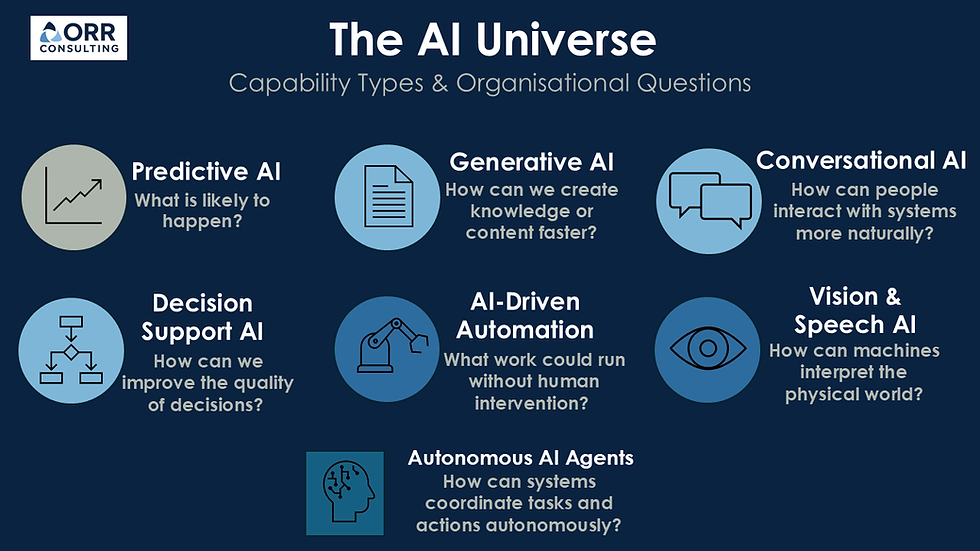
In the Orr Consulting AI Universe overview, AI-Driven Automation addresses a fundamental organisational question:
"What work could run without human intervention?"
Automation refers to technologies that enable tasks, processes or decisions to be executed automatically with limited or no human involvement.
While traditional automation has existed for many years through scripts, workflow systems and robotics, modern AI-Driven Automation expands what can be automated by enabling systems to interpret data, recognise patterns and adapt to changing conditions.
Automation can operate in many organisational environments, from digital workflows and operational systems to physical processes in manufacturing, logistics and service delivery.
For leaders and decision makers, automation can deliver significant operational benefits by improving efficiency, reducing manual effort and enabling organisations to operate at greater scale.
However, automation must be applied carefully. Automating poorly designed processes can simply accelerate inefficiency, while excessive automation can create operational risk if oversight and governance are weak.
Understanding where automation is appropriate and where human judgement should remain central is therefore essential when exploring AI-enabled operational improvement.

2. Why This Matters
Most organisations contain large numbers of repetitive, rule-based tasks that consume staff time.
These tasks may involve:
Processing transactions
Moving information between systems
Validating data or documents
Triggering standard operational workflows
Performing routine monitoring or checks
While each task may appear small individually, the cumulative operational burden can be substantial.
Automation allows organisations to reduce this burden by enabling systems to execute routine tasks consistently and at scale.
When implemented appropriately, automation can:
Improve operational efficiency
Reduce manual workload
Increase consistency of routine processes
Allow staff to focus on higher-value activities
However, automation is most effective when applied to well-understood processes. Attempting to automate poorly defined workflows often leads to complexity and limited benefit.
In the Orr Consulting AI Transformation Process, this Insight supports the Discover stage — building a shared understanding of AI capability, benefits and risk before governance and investment decisions are made.

3. In Practice
3.1 What Automation Is
Automation involves using technology to perform tasks or processes automatically based on defined rules, triggers or learned patterns.
In modern organisations, automation can take several forms, including:
Workflow automation within digital systems
Robotic process automation (RPA) handling structured digital tasks
AI-assisted automation interpreting data or documents
System integrations that trigger actions automatically across platforms
Automation is usually embedded within operational systems rather than accessed directly by users as a standalone tool. Staff typically interact with automated processes indirectly through the systems that support their work.
3.2 Important Distinction
Not all automation is AI.
Traditional automation follows predefined rules, workflows or scripts that execute the same actions whenever specified conditions are met. These approaches have delivered significant operational benefits for many years.
AI-Driven Automation extends this capability by enabling systems to interpret information, recognise patterns, make predictions or adapt decisions based on data rather than relying solely on fixed rules.
This distinction matters because organisations should not assume that every automation initiative requires AI. In many situations, conventional automation remains the simpler, lower-risk and more cost-effective solution.
3.3 Applicability
Automation is particularly effective when:
Tasks are repetitive and rule-based
Processes follow consistent workflows
Large volumes of transactions must be processed
Manual effort adds limited value
In these situations, automation can improve speed, consistency and scalability while reducing operational burden.
3.4 Common Use Cases
Automation is widely applied across many organisational contexts.
Common examples include:
Transaction processing — Automatically handling routine transactions such as approvals, payments or record updates
Data processing — Extracting, validating or transferring data between systems
Operational workflows — Triggering tasks or actions when predefined conditions are met
Monitoring and alerts — Detecting operational events and triggering notifications or responses automatically
Document processing — Extracting information from invoices, forms, applications or contracts and routing work automatically
3.5 What Automation Is Not
Automation is sometimes misunderstood as a universal solution to operational inefficiency.
In reality, automation does not:
Improve poorly designed processes automatically
Remove the need for governance or oversight
Replace human judgement in complex situations
Eliminate the need for operational accountability
Automation works best when applied to clearly defined processes that are already understood and well structured.
3.6 Benefits in Practice
Automation can deliver several organisational benefits when applied to appropriate processes.
Typical benefits include:
Increased operational efficiency — Enabling tasks to be executed faster and at greater scale
Reduced manual workload — Freeing staff to focus on more complex or strategic activities
Improved consistency — Ensuring processes follow the same logic every time
Greater operational resilience — Reducing dependence on manual intervention for routine tasks
3.7 Requirements for Success
Successful automation depends less on the technology itself and more on the organisational foundations around it.
This typically requires:
Well-understood processes, so tasks can be defined clearly and executed consistently
Reliable system integration, ensuring automated workflows interact correctly with existing systems
Clear operational ownership, defining who monitors automated processes and manages exceptions
Appropriate governance and controls, ensuring automation operates safely and transparently
3.8 Delivery Considerations
From an AI Project Management perspective, AI-Driven Automation is commonly delivered through both Configure and Build delivery modes. Organisations frequently configure automation capabilities within existing workflow, enterprise or robotic process automation platforms. More advanced automation initiatives that combine AI models, complex integrations or bespoke operational logic may require a Build delivery mode approach.
In typical organisational delivery terms, AI-Driven Automation sits in the medium-to-high range of the AI delivery complexity spectrum.
Delivery complexity often arises because automation spans multiple operational processes, business systems and organisational teams. Integration challenges, process redesign, exception handling, operational ownership and governance requirements can all significantly influence delivery effort.
For this reason, while AI-Driven Automation can deliver significant operational benefits, successful organisational adoption still benefits from a structured approach to AI transformation, including clear strategy, effective governance and disciplined delivery.
4. Risks
Key risks include:
Automating inefficient processes — Which can simply accelerate poor operational design
Over-automation — Reducing human oversight in situations that require judgement
Operational fragility — Where automated workflows fail if systems or inputs change unexpectedly
Unclear accountability — Making it difficult to identify responsibility when automated actions cause issues
5. Mitigating Actions
Leaders can reduce these risks by:
Prioritising process improvement before automation
Clearly defining operational ownership of automated processes
Ensuring automated workflows include monitoring and exception handling
Implementing proportionate governance and change control
Automation initiatives should be aligned with broader operational improvement rather than treated as isolated technology deployments.
6. Final Thoughts
Automation is one of the most established ways organisations can improve operational efficiency and scalability.
By allowing systems to handle routine tasks automatically, organisations can reduce manual effort and enable staff to focus on work that requires judgement, creativity and collaboration.
However, the benefits of automation depend heavily on good process design, reliable system integration and proportionate governance.
When implemented thoughtfully as part of a broader AI transformation approach supported by clear strategy, effective governance and disciplined delivery, AI-Driven Automation can become a core capability that strengthens operational performance and organisational resilience.
This Insight is part of the Orr Consulting AI Insights Library — structured thinking for AI transformation leaders and decision makers.
7. Call to Action
If your organisation is exploring automation opportunities, a useful starting point is to identify repetitive, high-volume processes where automation could improve efficiency while maintaining appropriate governance and oversight.
If you would like support identifying automation opportunities, shaping governance or integrating automation safely into operational services, Orr Consulting can help.
Subscribe to Orr Consulting to receive occasional emails with practical AI Insights and updates.