Generative AI — Capabilities, Limits and Risks for Leaders and Decision Makers
- Jan 22
- 7 min read
Updated: Jul 19
1. Insight
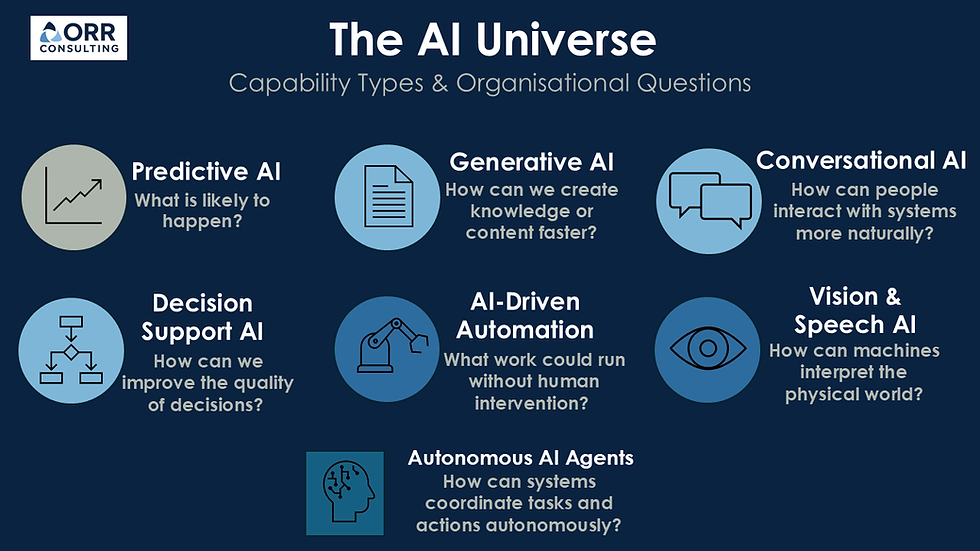
In the Orr Consulting AI Universe overview, Generative AI addresses a fundamental organisational question:
"How can we create knowledge or content faster?"
Generative AI is now the most widely used form of AI in the workplace. It is increasingly embedded within browsers, productivity suites, enterprise applications, mobile apps and search engines, making AI capabilities accessible as part of everyday work.
This technology is no longer experimental or “coming soon”. It is already shaping how work gets done — and it is here to stay.
At an individual level, Generative AI can support a wide range of everyday tasks: drafting documents, summarising information, brainstorming ideas, planning travel or producing first drafts at speed. In a business context, the potential applications are even broader — from supporting strategy development and communications, to analysing information, designing content, writing code and accelerating decision-making.
For leaders and decision makers, the challenge is rarely enthusiasm or resistance. It is understanding what Generative AI can do well, its limitations, how people are accessing it and what risks and controls need to be actively managed.
Used well, Generative AI becomes a practical productivity accelerator. Used poorly or without oversight, it can introduce avoidable risk, inconsistency and poor decision-making.

2. Why This Matters
Whether you are aware of it or not, your staff are already using Generative AI. In most cases, they are doing so with good intentions — to work faster, improve quality or reduce effort.
However, responsibility for AI use ultimately sits with organisational leadership. Leaders and decision makers must ensure that:
The right tools are being used
For the right purposes
With appropriate controls, oversight and governance in place
Unmanaged use creates risk. Managed use creates advantage. The difference is leadership, clarity and intent.
In the Orr Consulting AI Transformation Process, this Insight supports the Discover stage — building a shared understanding of AI capability, benefits and risk before governance and investment decisions are made.

3. Generative AI in Practice
3.1 What Generative AI Is
Most modern Generative AI tools are built using Large Language Models (LLMs), trained on vast volumes of text, code, images and other data. These models do not “think” or “understand” in a human sense. Instead, they identify patterns in data and generate outputs that appear similar to high-quality human-created content.
Their apparent intelligence comes from scale, training and design — not awareness or judgement.
In practice, Generative AI outputs are shaped by user-provided prompts — structured instructions that guide what the model produces, how it responds and the level of detail or style applied.
3.2 Generative AI Capabilities
Generative AI is best understood by the types of outputs it can create:
3.2.1 Text Generation
Drafting emails, reports, policies, summaries, proposals and plans. Use Case Example: A programme manager uses Generative AI to produce a first draft of a project update for senior stakeholders. By providing a short prompt outlining key milestones, risks and decisions required, the AI generates a structured and professional briefing note. The manager then reviews, refines and personalises the content before sending it.
Value Delivered:
Reduces drafting time significantly
Improves consistency and clarity
Allows leaders to focus on judgement, not formatting
Typical Applications:
Executive summaries
Policy and governance documents
Business cases and funding proposals
Meeting minutes and action summaries
3.2.2 Image Generation
Creating illustrations, concepts, diagrams and marketing visuals.
Use Case Example: A leadership team preparing a strategy presentation asks Generative AI to create a simple visual schematic illustrating their target operating model. The AI produces a clean, professional diagram that can be refined and branded, removing the need for specialist design support at the early concept stage.
Value Delivered:
Accelerates idea visualisation
Lowers dependency on external design resources
Enables rapid iteration of concepts
Typical Applications:
Strategy and operating model diagrams
Presentation visuals
Marketing and communication concepts
Training and learning materials
3.2.3 Audio and Video Generation
Producing voiceovers, transcripts, summaries and synthetic media.
Use Case Example: After a leadership town hall, Generative AI is used to automatically transcribe the session, summarise key messages and produce a short written briefing for staff who could not attend. In some cases, an AI-generated voiceover is created for internal training materials to ensure consistency of messaging.
Value Delivered:
Improves accessibility and inclusivity
Reduces time spent manually transcribing and summarising
Extends the value of live events and meetings
Typical Applications:
Meeting and workshop transcripts
Executive message summaries
Internal training videos
Knowledge capture and reuse
3.2.4 Code Generation
Writing, reviewing and explaining software code and scripts.
Use Case Example: A business analyst with limited coding experience uses Generative AI to create a simple data extraction script to automate a recurring report. The AI not only generates the code, but also explains what it does in plain English, allowing the analyst to validate, adapt and safely deploy it with appropriate oversight.
Value Delivered:
Accelerates automation and productivity
Lowers technical barriers for non-developers
Improves code quality through explanation and review
Typical Applications:
Simple automation scripts
Spreadsheet macros and formulas
Code review and documentation
Learning and capability uplift for teams

Across all capability areas, the pattern is consistent: Generative AI is most effective when it is used to accelerate first drafts, reduce manual effort and support human decision-making — not replace it.
The real value comes from pairing Generative AI outputs with clear intent, strong governance and active human oversight.
3.3 Benefits in Practice
When used well, Generative AI can deliver clear benefits:
Efficiency – significant time savings on drafting, summarising and repetitive tasks
Quality – more consistent outputs and fewer basic errors when used with review
Creativity – rapid idea generation, alternative perspectives and structured exploration of concepts and approaches
Reduced “blank page” effect – accelerating momentum by producing strong first drafts
3.4 When to Use Generative AI
Generative AI is most effective when:
The task is generative (drafting, ideation, summarisation, exploring or challenging existing assumptions)
Outputs can be iterated and refined
There is a clear need for human review and accountability
It is far less suitable for tasks requiring absolute accuracy, real-time data or unverified decision-making without oversight.
3.5 Limits of Generative AI
Even where Generative AI is used in appropriate scenarios, leaders and decision makers should understand its inherent limitations and the controls required to use it safely:
Human input and review are essential - Effective use requires good prompting and active human oversight.
It cannot learn independently - Models do not update their understanding unless explicitly retrained.
Accuracy is not guaranteed - Outputs can be incomplete, outdated or incorrect due to:
Limitations in training data
A fixed training cut-off date
Inherent model constraints
Where accuracy matters, outputs should be verified against trusted sources, organisational records or subject matter expertise. Generative AI should support judgement — not replace it.
3.6 Access and Adoption
Leaders and decision makers should understand the main access routes their teams are using:
ChatGPT: Available via web and mobile app, with free and paid tiers offering enhanced capability. Enterprise versions provide organisational controls and data protections.
Microsoft Copilot: Accessible via the web, mobile apps and embedded directly within Microsoft tools such as Word, Excel, Outlook and Teams under appropriate licensing.
Google Gemini: Available via web and mobile, with integration into Google Workspace tools such as Docs, Sheets and Gmail, alongside enterprise options.
Capabilities evolve rapidly, with new features and products released frequently. This makes clear guidance and governance essential.
3.7 Delivery Considerations
From an AI Project Management perspective, Generative AI is most commonly associated with the Configure delivery mode, where organisations adopt and integrate capabilities already available within commercial AI platforms and enterprise software. Where organisations develop bespoke Generative AI applications, integrate proprietary knowledge sources or build domain-specific AI assistants, a Build delivery mode approach may also be appropriate.
In typical organisational delivery terms, Generative AI sits in the medium range of the AI delivery complexity spectrum. While the underlying technology is readily accessible, organisational complexity increases as Generative AI becomes integrated into business processes, enterprise systems and governance arrangements.
Many organisations can begin experimenting with Generative AI quickly through widely available platforms such as ChatGPT, Microsoft Copilot and Google Gemini. However, moving beyond individual experimentation to secure, governed and operational use across the organisation introduces additional delivery complexity.
This may include integrating Generative AI with internal systems, managing sensitive organisational data, establishing appropriate governance controls and ensuring that outputs are reviewed and used responsibly.
For this reason, while Generative AI can appear simple to access, successful organisational adoption still benefits from a structured approach to AI transformation, including clear strategy, effective governance and disciplined delivery.
4. Risks
Without active leadership, Generative AI introduces several organisational risks:
Uncontrolled (Shadow AI) use outside approved tools and processes
Lack of awareness and education, particularly around data handling and residency
Responsible use failures, including misuse or over-reliance
Weak or absent governance
Uncoordinated use or poor use-case selection
Insufficient training, leading to sub-optimal outcomes
Failure to adopt, resulting in lost productivity and competitive disadvantage
5. Mitigating Actions
Leaders and decision makers can reduce risk and unlock value by taking proportionate action, including:
Setting clear Generative AI usage principles
Defining approved tools and access routes
Establishing governance and accountability
Training teams to use AI effectively and responsibly
Aligning AI use to real business outcomes
6. Final Thoughts
Generative AI is not a future capability — it is already reshaping how work happens. The question for leaders is no longer whether it will be used, but how well it will be used.
This related insight Generative AI — Maximising Benefits with Prompt Engineering, focuses on a simple, practical framework for creating high-quality prompts that dramatically improve Generative AI outputs and can be applied immediately by leaders, decision makers and teams.
This Insight is part of the Orr Consulting AI Insights Library — structured thinking for AI transformation leaders and decision makers.
7. Call to Action
If you want to take control of Generative AI use in your organisation — reducing risk while unlocking real productivity gains — now is the time to act.
Explore how Orr Consulting can help you turn Generative AI from an unmanaged risk into a disciplined capability that delivers measurable outcomes.
Subscribe to Orr Consulting to receive occasional emails with practical AI Insights and updates.