Conversational AI — Capabilities, Benefits and Risks for Leaders and Decision Makers
- Jan 20
- 6 min read
Updated: Jul 19
1. Insight
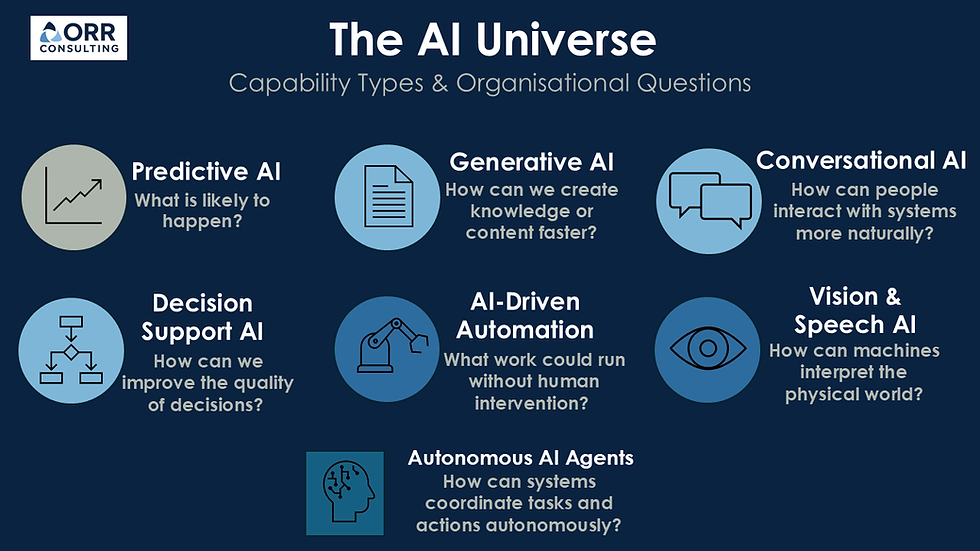
In the Orr Consulting AI Universe overview, Conversational AI addresses a fundamental organisational question:
"How can people interact with systems more naturally?"
Conversational AI refers to systems that allow people to interact with digital services using natural language through text or speech.
Examples include chatbots, virtual assistants and AI-powered service agents that can answer questions, guide users through processes and help resolve issues. These systems are increasingly used across customer service, employee support, public services and digital platforms.
For leaders and decision makers, conversational AI represents one of the most visible and accessible applications of AI. When implemented well, it can improve service accessibility, reduce operational pressure and provide faster responses to common enquiries.
However, conversational AI also introduces delivery considerations. Poorly designed systems can frustrate users, provide unreliable answers or create reputational risk if responses are inaccurate or inappropriate.
Understanding both the potential and the limitations of conversational AI is therefore important when considering where it can deliver meaningful organisational benefits.

2. Why This Matters
Many organisations face increasing demand for information and support services while operating with constrained resources.
Customer enquiries, internal support requests and service interactions can generate large volumes of repetitive questions and transactions. These interactions often require staff time even when the answers are straightforward or well documented.
Conversational AI can help address this challenge by providing an additional digital interaction channel that is available continuously and capable of handling routine requests at scale.
When deployed appropriately, conversational AI can:
Improve accessibility to information and services
Reduce waiting times for routine enquiries
Allow staff to focus on higher-value or complex work
Provide consistent responses across large volumes of interactions
However, conversational AI should not be seen simply as a technology deployment. Effective adoption requires thoughtful service design, clear governance and a realistic understanding of where automated interaction is appropriate and where human judgement remains essential.
In the Orr Consulting AI Transformation Process, this Insight supports the Discover stage — building a shared understanding of AI capability, benefits and risk before governance and investment decisions are made.

3. In Practice
3.1 What Conversational AI Is
Conversational AI enables users to interact with digital systems using natural language rather than traditional menus or forms.
Interactions may occur through:
Text interfaces such as chatbots or messaging platforms
Voice assistants using speech recognition and speech synthesis
Integrated digital assistants embedded within applications or services
Conversational AI is often directly accessible to users through chat or voice interfaces. However, effective organisational conversational AI typically depends on underlying systems, knowledge sources and workflow integration rather than the interface alone.
Modern conversational systems frequently combine several AI capabilities to deliver effective interactions. Conversational AI provides the interaction layer that allows people to communicate with digital systems using natural language.
3.2 Important Distinction
Not every chatbot or digital assistant is necessarily AI.
Some systems rely primarily on predefined rules, scripts, menus or decision trees. These may provide useful digital automation, but their responses are largely determined in advance through explicit human-written rules.
They may look conversational, but they may not meet the practical definition of AI used in the Orr Consulting AI Universe.
Conversational AI becomes increasingly more AI-enabled when it uses learned language patterns, intent recognition, generative AI or other AI capabilities to support more natural and adaptive interaction.
This distinction matters because organisations should not mistake a rules-based conversational interface for the full potential of AI-enabled conversational service.
3.3 Applicability
Conversational AI is particularly applicable when:
Users frequently ask similar questions or request similar information
Processes follow structured workflows
Responses can be drawn from reliable knowledge sources
Immediate assistance improves the user experience
Typical examples include answering common enquiries, guiding users through digital services or providing quick access to organisational knowledge.
In these scenarios, conversational AI can significantly improve response times while reducing pressure on support teams.
3.4 Common Use Cases
Conversational AI is commonly applied in the following areas:
Customer Service Assistants — handling routine enquiries such as account questions, service availability or appointment information
Internal Knowledge Assistants — helping employees quickly find policies, procedures or operational guidance
Service Navigation — guiding users through complex digital services or application processes
Digital Front Doors — providing an accessible first point of contact for citizens, customers or employees seeking assistance
3.5 What Conversational AI Is Not
Conversational AI is sometimes misunderstood as a replacement for human interaction.
In reality, most successful implementations use conversational systems to complement human services rather than replace them entirely.
Conversational AI does not:
Fully replicate human understanding or judgement
Work reliably without well-structured information sources
Remove the need for oversight and governance
Eliminate the need for human support in complex or sensitive situations
Without careful design, conversational systems can quickly lose user trust if responses appear inaccurate or unhelpful.
3.6 Benefits in Practice
Conversational AI can deliver several benefits that matter to leaders, particularly in service-intensive environments.
Typical benefits include:
Improved service accessibility — allowing users to obtain assistance quickly without navigating complex digital interfaces
Reduced operational pressure — enabling routine enquiries to be handled automatically so staff can focus on more complex or sensitive issues
Consistent information and guidance — with responses drawn from approved organisational knowledge sources
Faster access to information — allowing users to obtain answers immediately rather than waiting for manual responses
3.7 Requirements for Success
Conversational AI succeeds less because of sophisticated technology and more because organisations have addressed the fundamentals.
This typically requires:
Reliable knowledge sources — so responses are based on accurate, well-maintained information such as service documentation, policy guidance or knowledge bases
Clear service design — so organisations define when conversational AI should handle interactions and when human support should take over
Governance and oversight — so systems are monitored to ensure responses remain accurate, appropriate and aligned with organisational policies
Integration with operational processes — so conversational systems connect with underlying services and allow users to complete actions rather than simply receive information
3.8 Delivery Considerations
From an AI Project Management perspective, Conversational AI is most commonly associated with the Configure delivery mode, where organisations implement and integrate conversational capabilities already available within commercial AI platforms, customer service solutions and enterprise applications. Where organisations develop bespoke conversational assistants, integrate proprietary organisational knowledge or build domain-specific conversational services, a Build delivery mode approach may also be appropriate.
In typical organisational delivery terms, Conversational AI sits in the medium range of the AI delivery complexity spectrum.
Delivery complexity varies depending on whether the organisation is implementing a rules-based conversational interface, an AI-enabled assistant using learned language capabilities, or a more advanced conversational service that combines knowledge retrieval, workflow integration and emerging agentic capability.
Many organisations can begin experimenting with conversational interfaces relatively quickly using existing conversational AI platforms or enterprise AI services. However, moving from experimentation to reliable operational service delivery introduces additional complexity.
This may include integrating Conversational AI with internal systems, maintaining accurate knowledge sources, managing data privacy, establishing governance controls and ensuring appropriate escalation to human support where required.
For this reason, while Conversational AI may appear straightforward to deploy, successful organisational adoption still benefits from a structured approach to AI transformation, including clear strategy, effective governance and disciplined delivery.
4. Risks
Key risks include:
Poor user experience — if conversational systems fail to understand user intent or provide incorrect responses, user frustration can increase rather than decrease
Knowledge accuracy — AI responses are only as reliable as the information sources they rely on
Over-automation — automating interactions that require empathy, judgement or complex problem-solving can damage trust and service quality
Governance and accountability — organisations must remain accountable for the responses provided by AI systems
5. Mitigating Actions
Leaders can reduce these risks by:
Distinguishing between rules-based automation and AI-enabled conversational capability
Prioritising appropriate use cases
Maintaining reliable knowledge sources
Implementing clear escalation pathways to human support
Establishing governance and monitoring mechanisms
Conversational AI should be introduced as part of broader service design rather than as a standalone technology deployment.
6. Final Thoughts
Conversational AI is one of the most visible and accessible forms of AI within modern organisations.
However, organisations should recognise that not all conversational interfaces represent equivalent levels of AI capability. Understanding the distinction between rules-based automation and AI-enabled conversational systems is increasingly important when evaluating opportunities, risks and potential benefits.
When applied to the right use cases, it can improve service accessibility, reduce operational pressure and provide faster access to information for users.
However, Conversational AI is most effective when implemented as part of a broader AI transformation approach supported by clear strategy, effective governance, thoughtful service design and disciplined delivery.
This Insight is part of the Orr Consulting AI Insights Library — structured thinking for AI transformation leaders and decision makers.
7. Call to Action
If your organisation is exploring conversational AI, a useful starting point is to identify high-volume interactions where conversational interfaces could improve service accessibility while maintaining appropriate governance and oversight.
If you would like support identifying conversational AI opportunities, shaping governance or integrating conversational AI safely into operational services, Orr Consulting can help.
Subscribe to Orr Consulting to receive occasional emails with practical AI Insights and updates.