Glossary for the Orr Consulting AI Insights Library
- Jan 9
- 7 min read
1. Glossary
The glossary explains the terminology used throughout the AI Insights Library and introduces the concepts that underpin the Orr Consulting approach to AI transformation.
Each term links to the AI Insight where the concept is explored in more detail, allowing readers to navigate the library by concept.
A
Agile - An iterative delivery approach where work is developed in increments, allowing adaptation based on feedback and evolving requirements.
AI Acceptable Use Policy - A policy that defines how AI tools can be used safely, responsibly and in line with organisational standards.
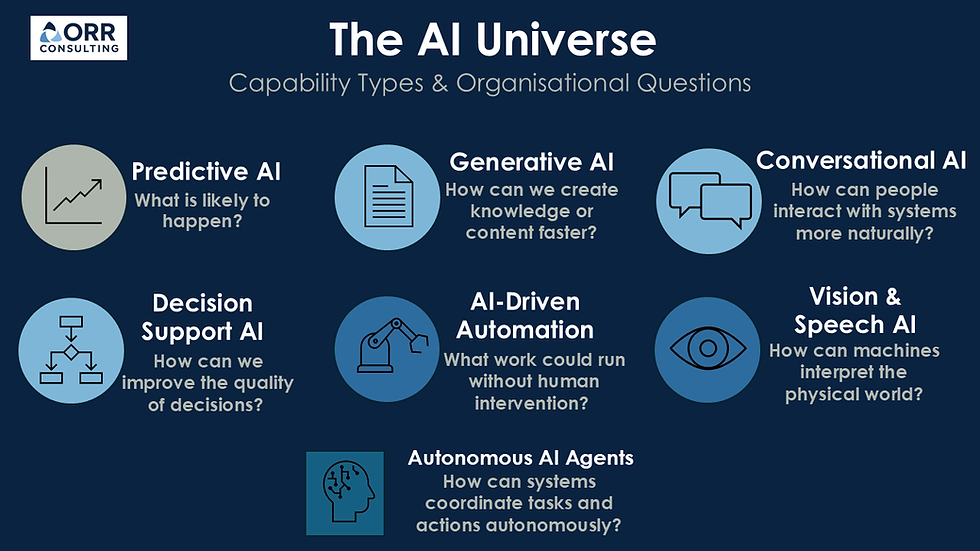
AI Capability - A specific type of task or function that artificial intelligence systems can perform, such as prediction, generation, automation or decision support.
AI Capability Radar - A structured assessment visual showing an organisation’s capability maturity across key AI dimensions.
AI Data Governance and Assurance Policy - A policy defining how data used in AI should be governed, controlled and protected.
AI Delivery Modes - The main ways AI solutions are delivered in practice, including custom development, configuration of AI-enabled vendor solutions and user-led adoption.
AI-Driven Automation - AI capabilities used to automate tasks and workflows.
AI Education and Training Policy - A formal policy defining expectations for AI awareness and capability development across the organisation.
AI Governance and Assurance Framework - The overall structure of policies, controls, responsibilities and assurance mechanisms used to govern AI adoption responsibly.
AI Insights Library - The structured collection of AI Insights and case studies published by Orr Consulting to help organisations understand, plan and deliver AI adoption.
AI Maturity - The overall level of organisational readiness to adopt and manage artificial intelligence effectively.
AI Roadmap - A sequenced plan that defines the priority initiatives, milestones and timing for implementing an organisation’s AI strategy.
AI Services - The advisory and delivery services provided by Orr Consulting to support structured AI transformation.
AI Strategic Priority Outcomes - The key organisational results that an AI strategy is intended to deliver.
AI Strategy - A structured plan defining how artificial intelligence will support organisational objectives.
AI Technical Governance and Assurance Policy - A policy defining how AI technologies and technical controls should be governed.
AI Transformation Process - The structured Orr Consulting framework used throughout the AI Insights Library to guide organisations from understanding AI to delivering measurable value.
AI Universe - The Orr Consulting conceptual model explaining the core categories of artificial intelligence capability and how they relate to organisational problems.
AI Vision Statement - A concise statement describing the intended future role and impact of artificial intelligence within an organisation.
Approval Gateway - A formal decision point used to confirm whether an initiative is ready to progress to the next stage.
Artificial Intelligence - Technology that enables computer systems to analyse data, identify patterns and support decision-making or automation.
Assumptions - Conditions believed to be true for planning purposes that influence strategy, investment or delivery decisions.
Autonomous AI Agents - AI systems capable of independently performing tasks and coordinating activities with minimal human intervention.
B
Baseline - An initial reference point used to understand current capability or performance.
Benefit - A measurable improvement resulting from an initiative.
Benefit Profile - A structured description of an expected benefit including measurement method, ownership and timing.
Benefits Realisation - The process of ensuring initiatives deliver measurable organisational value.
Blueprint - A description of the future operating model or capability that a programme aims to deliver.
Business Case - A structured justification for investment setting out expected benefits, costs and risks.
Business Case Development - The process of analysing and preparing the investment rationale for an initiative.
Business-led - An approach where AI activity is driven by organisational priorities rather than technology enthusiasm.
C
Capability and Maturity Assessment - A structured evaluation used to determine how prepared an organisation is to adopt AI.
Capability Baseline - The starting point used to understand current organisational capability.
Capability Gap Analysis - The comparison between current capability and the capability required to achieve strategic objectives.
Capability Maturity - The degree to which organisational capability is developed and reliable.
Capability Pillar - A key dimension used to assess organisational AI capability and maturity.
Case Study - A practical example illustrating how concepts from the AI Insights Library can be applied within an organisational context.
Chain-of-Thought Prompting - A generative AI prompting technique that encourages step-by-step reasoning.
Chatbot - A conversational AI system designed to interact with users through text or voice.
Confidence Gap - The situation where leaders recognise the importance of AI but lack clarity about organisational readiness.
Conversational AI - AI systems designed to interact with humans through natural language conversation.
Cost and Investment Profile - A structured view of expected costs and investment requirements over time.
Culture - Organisational behaviours, attitudes and norms that influence how AI is understood and adopted.
Current State - A description of an organisation’s existing capabilities, processes and maturity.
D
Data and Confidentiality Risk - The risk that sensitive information may be exposed through the use of AI tools.
Data Readiness - The extent to which data is available, accessible and suitable for AI use.
Decision-Making Risk - The risk that AI outputs may influence decisions inaccurately or without sufficient understanding.
Decision Support AI - AI systems that recommend actions or support human decision-making.
Delivery Complexity - The degree of difficulty associated with implementing an AI initiative.
Delivery Stage - The phase of the AI Transformation Process where AI initiatives are implemented.
Dependencies - Relationships between initiatives where one activity relies on another to succeed.
Design Stage - The phase of the AI Transformation Process where strategy, governance and investment decisions are defined.
Discover Stage - The phase of the AI Transformation Process focused on building understanding of AI and identifying opportunities.
Dis-benefit - A negative consequence arising from an initiative, which should be identified and managed alongside expected benefits.
E
Education and Training - Activities designed to improve organisational understanding of artificial intelligence capabilities and risks.
Embedded - AI capabilities integrated directly into existing software or workflows.
End-to-End - A mode of applying the AI Transformation Process across the full journey from understanding AI through to delivery and value realisation.
EU Artificial Intelligence Act - A regulatory framework governing the development and use of artificial intelligence within the European Union.
Evidence-Based - An approach grounded in structured assessment, data and observable evidence rather than assumptions.
F
Few-Shot Prompting - Providing examples within prompts to guide AI responses.
False Confidence - Over-reliance on AI outputs that appear more reliable than they actually are.
Focused - A mode of applying the AI Transformation Process that concentrates effort on the most relevant stages or steps for a specific organisational need.
Functional Capability - The ability to apply AI effectively within real organisational processes and operations.
Future State - A description of the intended organisational capability after transformation.
G
Generative AI - AI systems capable of producing new content: text, images, audio, code or summaries, based on prompts and context.
Generative AI Tools - Applications that use generative AI models to produce outputs such as text, images, code or summaries.
Governance and Assurance - Structures used to manage risk and ensure responsible AI use.
H
Health Check - A structured review used to assess an organisation’s current AI capability, maturity and readiness before significant AI investment or delivery begin.
Human in the Loop - Human oversight applied to AI outputs or decisions before they are acted upon.
I
Issue - A problem or concern requiring management and resolution during delivery.
Iterate - The process of refining prompts or approaches through repeated improvement.
M
Machine Learning - A form of AI where systems learn patterns from historical data.
MSP - (Managing Successful Programmes) A structured programme management method used to deliver large-scale change.
O
Options Appraisal - A structured comparison of potential approaches, including a long list and refined shortlist, used to identify a preferred option for investment.
Order of Magnitude of Investment - An early estimate of the approximate investment required.
Outcome - A measurable change resulting from project or programme outputs.
Output - A direct deliverable produced by a project.
P
Performance Degradation - Declining accuracy of an AI system over time.
People Readiness - The extent to which stakeholders understand, trust and are prepared to adopt AI in practice.
Piecemeal - A mode of AI adoption where activity develops in a fragmented way, often beginning with a specific urgent problem rather than through a structured end-to-end process.
Pilot - A limited initial implementation used to test a concept.
PMO (Project or Programme Management Office) - An organisational function that provides governance, reporting and coordination support across programmes and projects.
Predictive AI - AI systems that analyse historical data to forecast future outcomes.
PRINCE2 (Projects in Controlled Environments) - A structured project management method.
Programme Management - The coordinated management of related projects to deliver strategic outcomes, change and benefits.
Project Management - The structured delivery of individual initiatives.
Prompt - The instruction given to a generative AI system.
Prompt Chaining - Using multiple prompts in sequence.
Prompt Engineering - The structured design of prompts to improve AI output.
Prompting Framework - A structured method for designing effective prompts.
R
Regulatory and Compliance Risk - Risk of breaching legal or regulatory requirements.
Reputational Risk - Risk of damage to organisational credibility.
Risk - A potential event or condition that could negatively affect the successful adoption, governance or delivery of an initiative.
ROI (Return on Investment) - A measure of financial value from an investment.
S
Scalable - The ability of an approach, capability or transformation process to expand and support wider organisational use over time.
Scope - The boundaries of what a delivery project will deliver.
Shadow AI - Use of AI tools without organisational oversight.
SMART - A framework for defining clear and measurable objectives or benefits: Specific, Measurable, Achievable, Relevant and Time-bound.
Sponsor - The senior leader responsible for ensuring that a strategy, programme or initiative delivers its intended organisational outcomes and benefits.
Stakeholder - An individual, group or organisation that has an interest in, or may be affected by, an AI initiative, programme or project.
T
Technical Capability - Technical skills and infrastructure needed for AI.
Tolerance - Permitted project control variation before escalation.
Tranche - A delivery segment within a programme.
U
Use Case Discovery - The structured process of identifying and prioritising AI opportunities.
V
Virtual Assistants - Conversational AI tools used to support tasks.
Vision & Speech AI - AI technologies that interpret visual information or speech.
W
Waterfall - A traditional delivery approach where requirements and scope are defined upfront and delivery progresses through sequential phases.